Services & Knowledge / Knowledge
Knowledge
Real-world questions.
Which insulating flange connection is best suited for which application? What should be kept in mind during installation? How do HP2 and HQ2 differ in practice? And what does CCP protection specifically mean for my system?
In our Knowledge Center, we compile the questions we’re asked most frequently by operators, designers, and installers—and answer them clearly and with technical precision. This is supplemented by articles and technical papers that delve deeper into the topics: regulations, material suitability, testing procedures, H₂ compatibility, and more.
Subject Area
What is the difference between an ISOFLANGES block flange connection and conventional flanges?
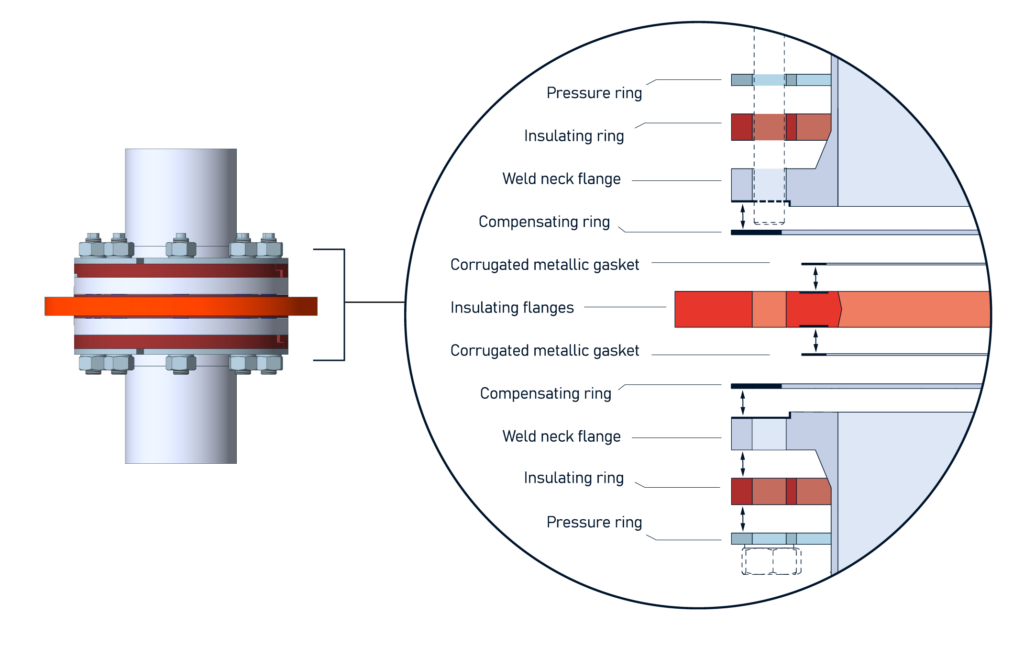
ISOFLANGES’ HP2 is designed as a heavy-duty block flange connection. Compensating rings and gaskets fit into precise grooves, forming a gap-free assembly.
Unlike many conventional insulating flanges, in which sealing and insulating elements often merely rest on the surface or make contact only at specific points, HP2 features a closed-block design. This design allows it to withstand higher compressive, shear, bending, and torsional forces than conventional insulating flange connections.
For the plant, this means that the separation point is designed for maximum tightness and mechanical stability, reducing testing and maintenance requirements to a minimum.
Why does ISOFLANGES use full-contact screw seats instead of insulating U-washers for most of its products?
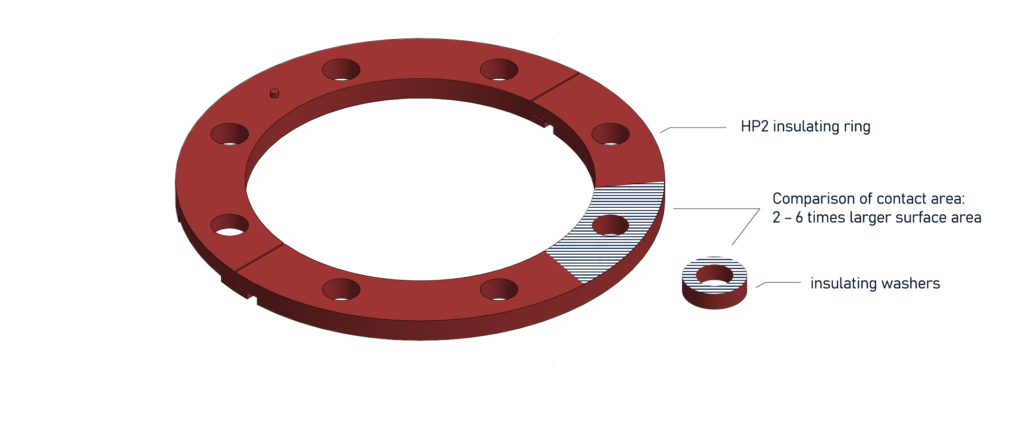
Instead of U-shaped insulating washers that provide localized support, ISOFLANGES uses insulating rings with a continuous contact surface across the entire flange diameter. This distributes the bolt tightening torque over a much larger area.
This allows for higher tightening torques, a deformation-free joint, and—as intended by the design—up to 100% bolt utilisation. The result: The bolted joint is utilized more effectively, and the connection remains stable and leak-tight even under load.
What versions of ISOFLANGES's best-selling HP2 are available—and what are they suitable for?
HP2 is available in several versions that cater to different applications:
- HP2 – Liquids and Gases (including H2 and CO2)
Maintenance-free, pressure-resistant insulation and corrosion protection for liquid and gaseous media—from natural gas to 100% hydrogen and CO2.
- HP2 KKS5 Conversion System
Turns existing ASME and DIN flange connections into a code-compliant, 100% CCP-effective insulating point with an installation length of just 5 mm—without requiring any modifications to the pipe fittings.
- ISO‑KonneX
Applies HP2 technology to clamp and cutting-ring connections, enabling electrical isolation and CCP concepts even in screw-type connection systems.
- HP2 B Version (limited installation space)
A version optimized for minimal overall length with a single-sided insulating pressure ring combination—for full-featured insulation points directly on valves and in tight installation spaces.
- HP2 – Drinking Water and Tap Water
Specialized materials and sealing systems for permanently leak-proof, hygienically safe, and code-compliant water applications.
- HP2 – aggressive and corrosive fluids
Version with precisely fitting inliners that protect the flange and flange facing surfaces and safely guide the fluid through the separation point.
- HP2 HTG (High Temperature)
For high temperatures and continuous thermal stress, when standard solutions reach their limits in terms of leak tightness.
What is the advantage of the tapered reduction in the HP2 flange?
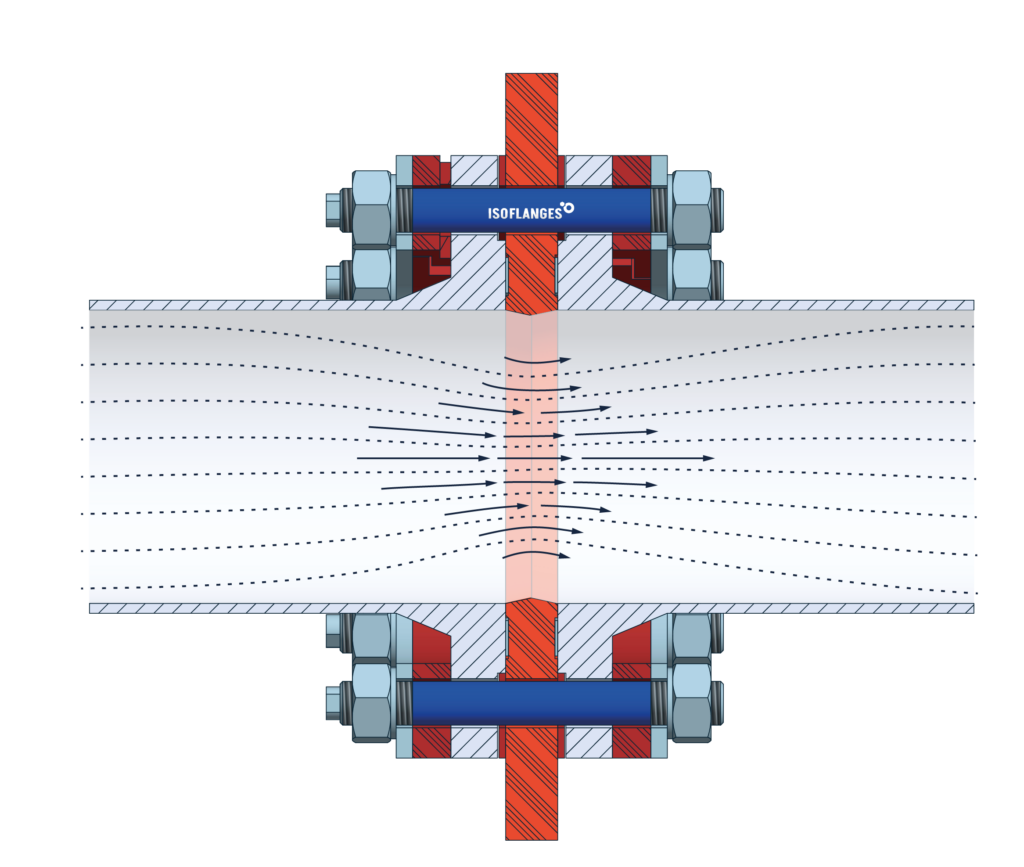
In the HP2, a flanged cone reduces the cross-sectional area at the separation point. This increases the flow velocity of the medium, reliably prevents deposits, and extends the service life of the separation point.
Especially in critical pipelines—from long-distance pipelines to drinking water applications—this conical guide reduces the risk of the medium settling at the insulation point and putting stress on the connection over time.
What does the gap-free transition from the weld neck flange to the insulating flange mean?
ISOFLANGES block flanges are designed so that the transition from the weld neck flange to the insulating flange is gap-free. There are no gaps at the interface between the pipe, the weld neck flange, and the insulating flange.
In combination with the conical reducer, this gap-free transition promotes a deposit-free flow and helps ensure that the separation point remains mechanically and hydraulically stable throughout the system’s service life.
What tests do HP2 insulating flanges undergo before shipment?
HP2 insulating flanges are tested as a complete unit and certified in accordance with the relevant regulations. These include, among others:
- FAT (final acceptance testing)The connection is tested as a complete insulating flange and certified in accordance with DIN EN 1594, DIN EN 12007-3, DVGW G 462 / G 463, DVGW GW 24, and TRFL § 9, para. 5, Part 2.
- Leak TestsMulti-stage leak tests with test pressures exceeding 1.1 × DP and graduated hold times demonstrate that the connection remains permanently leak-tight even under operating pressure.
- Strength TestA triple pressure test on the seal between 10 bar and 85% STP, followed by a strength test at 1.5× DP (holding time of 30 minutes, using deaerated water), confirms the mechanical reserves of the joint.
- High-Voltage TestingA high-voltage test at 5,000 V / 50 Hz for 1 minute, with a threshold of 10 mA, ensures electrical insulation strength.
- DC Voltage TestAn insulation resistance test using 500 V DC and a minimum threshold of 0.1 MΩ verifies that electrical isolation is secure.
What documentation do operators receive when purchasing insulating flanges?
Every HP2 insulating flange connection is delivered with specified tests and complete project documentation. The connection is accepted as a prefabricated component, has been mechanically and electrically tested, and is accompanied by all necessary certification. In this way, separation points become transparent safety features of a system that can be verified at any time.
The documentation includes, in particular:
- Acceptance Test Certificate APZ 3.1 in accordance with DIN EN 10204
- Declaration of Conformity and CE Marking in accordance with the Machinery Directive 2014/68/EU (Module H)
- Documents for FAT (final acceptance testing)
The materials used are designed in accordance with DIN 30690 and AD 2000; the required tightening torque is indicated on the nameplate. The achieved leak-tightness values meet at least the requirements of the TA Luft and are therefore clearly verifiable by testing and approval authorities.